

Welcome to the 140th edition of the Weekly Round-Up — your once-a-week digest filled with copywriting insights, AI tips, must-read articles, pretty cool copy examples, and more!
In this week’s issue:
Copy Tip: Vague is a claim. Specific is proof.
AI Tip: A constraint beats an instruction, almost every time.
Steal My Creative Strategy Process (via Jessie Healy)
A Brand Consultant’s First Question: Who Are You Willing to Lose? (via Copywriter Collective)
Brand as software via (Kimchi Gabagool)
Video Pick: DTC Offer Strategy: Raising Your Prices Without Losing Conversions (via Brian Ng, Scalability School)
Swipe File Additions
Job opportunities
Copy Tip of the Week
Vague is a claim. Specific is proof.
“Fast shipping” could mean anything. Two days, same day, “faster than our competitors” — you don’t know, and neither does your reader, so their brain subconsciously discounts it. It costs nothing to say “fast.”
“Ships in 6 hours” is a different kind of sentence. It’s a number someone could check. And that’s exactly why it works — because a specific claim is expensive to fake. Your reader’s brain treats it as evidence instead of marketing.
This is why “just be more specific” actually works as feedback, even though it sounds too simple to matter.
Go through your last email, landing page, whatever. Every claim that could apply to literally any competitor (i.e. high quality, trusted by thousands, made with care) is costing you credibility instead of building it. Replace it with the version a fact-checker couldn’t argue with.
Sure, vague sounds safer to write. But specificity is what actually gets believed.
AI Insight of the Week
A constraint beats an instruction, almost every time.
“Write it in a friendly tone” has thousands of valid answers. Claude picks one, and it’s usually the most statistically average version of “friendly,” which is probably the exact type of AI-sounding output you’re trying to avoid.
“Don’t use a single exclamation point” has way fewer valid answers. You’ve just ruled out the laziest way to signal friendliness, which forces the model to find friendliness somewhere else (i.e. word choice, rhythm, specificity).
A positive instruction points at a whole territory and lets the model land wherever’s easiest to reach while a constraint removes the easy way out. Instructions ask “what do you want,” and the model guesses. Constraints tell it what’s off the table, and there’s nothing left to guess.
Next time you’re prompting and the output feels generic, don’t add another adjective. Take something away instead:
“Rewrite this, but you can’t use the word ‘unlock’ or ‘quietly’.”
“Same idea, minus any sentence longer than 12 words.”
“Keep the point, lose every rhetorical question.”
You’ll get something with actual shape to it because the model had to find a way around the wall you put up, instead of coasting to the nearest cliché.
Must-Read Articles
Steal My Creative Strategy Process
(via Jessie Healy)
Why I recommend it: Jessie Healy’s argument: the format isn’t the idea, it’s just the container, and most brands skip straight to “let’s do a UGC ad” without ever answering what problem they’re actually solving or which emotion they’re tapping into. Check her four research sources 100% worth stealing.
A Brand Consultant’s First Question: Who Are You Willing to Lose?
(via Copywriter Collective)
Why I recommend it: Every brand consultant asks who you’re for. Jack Stafford asks who you’re willing to lose – because a deck can hold two contradictory ideas on consecutive slides, but a sentence can’t, and that’s where the “second customer” nobody wrote into the brief usually gets exposed.
Brand as software
(via Kimchi Gabagool)
Why I recommend it: Brand guidelines can describe the brand, but it can’t participate in the work, which is why 375 Slack requests hit Ramp’s design queue in six months and the guideline just kept getting outgrown, one reasonable exception at a time. His fix, “brand as software”.
Podcast/Video Pick of the Week
DTC Offer Strategy: Raising Your Prices Without Losing Conversions via Brian Ng, Scalability School
Why I recommend it: A brand stuck under six figures a month almost always has an offer problem, not a creative problem — proven by a client who went from -$24K to a projected $50K net profit in two months. How? Well, watch the episode and find out!
Pretty Fly Copy
🔓 Want access to my entire swipe file database?
Subscribe here to unlock the magic link.
HOWLER BROS
Format: Email
Why I like it: To be transparent, copy-wise, I feel like Howler’s emails are often mid. But this one has a little pop of personality starting with the subject line. I also liked the cross-sell for the whole collection at the end: “Don’t stop at your bottom!”

TRANSPARENT LABS
Format: Email
Why I like it: The headline is doing A LOT of work here. But honestly, the whole email’s excellent and has all the needed proof points for someone who’s problem aware. If they included something like “Over 4,000 5-star Reviews,” it’d be a banger.

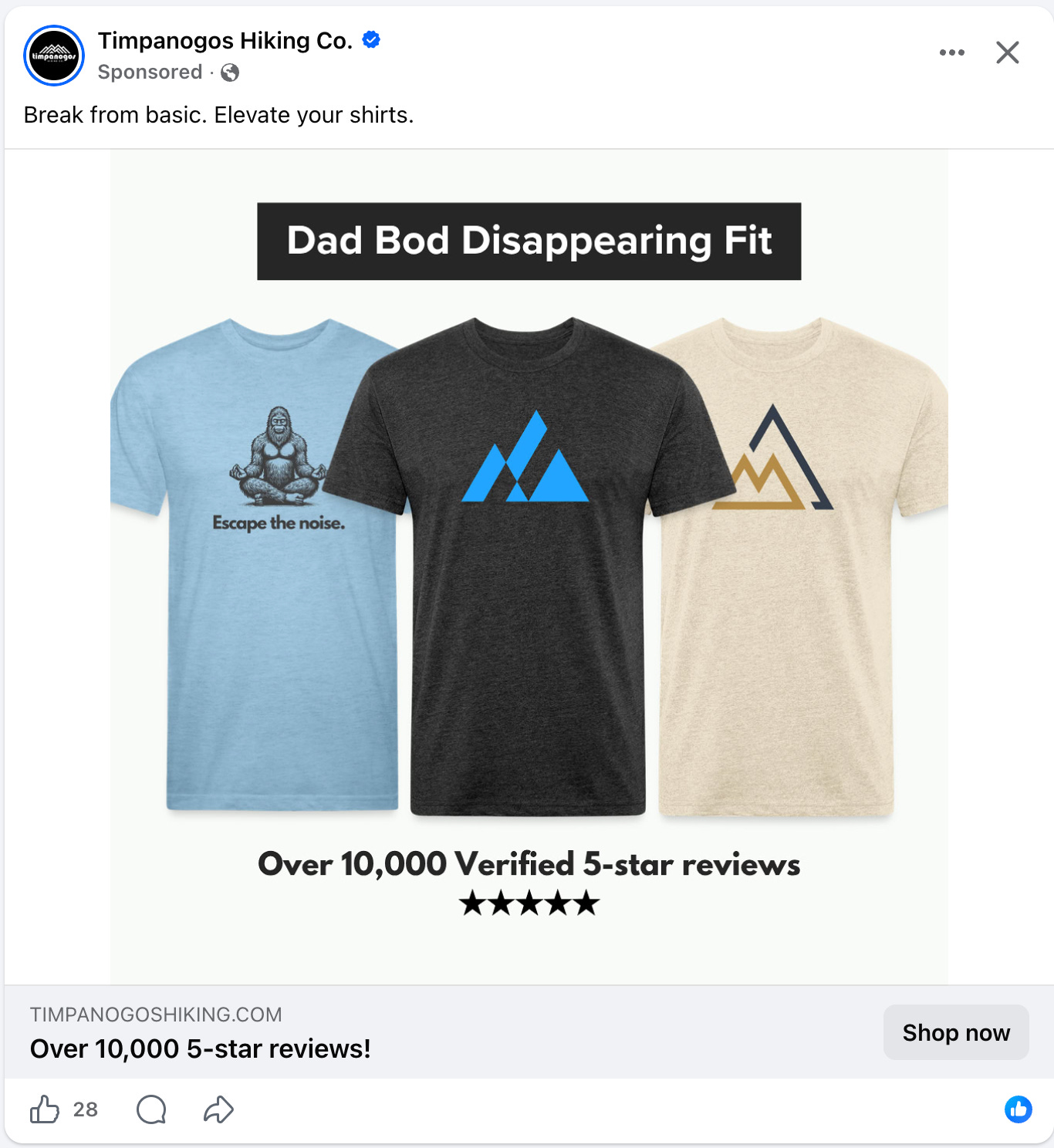
TIMPANOGOS HIKING CO.
Format: Facebook Ad
Why I like it: Ads don’t have to be overcomplicated. I wished they’d ditched the 2nd sentence in the primary text and only said, “Break from basic.” But “Dad Bod Disappearing Fit” is pretty good, and 10K+ reviews to back it up? Not bad proof.
Job Opportunities
Copywriter - Part-time (Everlane; HYBRID)
Copywriter (Skill)
Freelance Copywriter (Good Inside)
Copywriter (The Rise Collective)
Freelance Content Creator – Overheard (Doing Things)
That’s it for this week! If you have questions or comments — drop a note below.
✌️
Matt
Are you new here? Thinking about subscribing? Here’s what else you can expect.