

Welcome to the 139th edition of the Weekly Round-Up — your once-a-week digest filled with copywriting insights, AI tips, must-read articles, pretty cool copy examples, and more!
In this week’s issue:
Copy Tip: Benefits vs. Payoffs
AI Tip: Claude’s memory can save you from re-briefing
How to Hire a Freelance Copywriter Who’s Already Booked (via Copywriter Collective)
FTC Puts Personalized Pricing Practices on Notice (via MarTech)
Copywriters have a fundamentals issue (via Dustin Dooling)
Podcast Pick: DTC vs B2B Marketing
Swipe File Additions
Job opportunities
Copy Tip of the Week
A benefit is a fact. A payoff is a scene.
“Saves you time” is a benefit. True, useful, and completely forgettable, because nobody’s life gets better in the abstract. Nobody lies awake wanting “more time” — they want what the time gets spent on.
“So you can actually eat dinner with your kids before they’re too old to want to” is the payoff. Same fact. Now it’s a moment your reader can see themselves in.
Read your benefit line, then ask “so what happens because of that?”
If you can answer in one more sentence, you haven’t hit the payoff yet — you’ve hit a fact that has a payoff hiding behind it.
Keep asking “so what” until the answer is a specific person doing a specific thing at a specific moment. That’s the floor. You can’t go “so what” past a scene.
Most copy stops one layer too early, because the benefit already feels like an accomplishment. It named the value! It’s true! But “true” isn’t the bar. The bar is: did the reader picture something?
Run this on your last promo. Whatever benefit you led with, push it one more “so what” and see what shows up.
AI Insight of the Week
Claude can carry stuff across chats — your preferences, what you’re working on, how you like things explained.
Tell it once (”when I say ‘meh,’ cut it down and make it more conversational”), and you stop re-explaining your voice every session.
Here’s the part that trips people up, though: it’s not logging your words in real time. It’s running a background process, periodically, that boils your chat history down into a handful of patterns. Not a transcript. A summary.
So if something you said doesn’t show up later, that’s not necessarily a bug:
It takes a beat — a correction won’t always register in your very next message.
It’s hunting for patterns, not jotting down one-offs. Phrase the thing as a standing rule (”from now on, always...”) instead of a passing comment, and it has a much better shot at sticking.
If it actually matters, don’t rely on memory alone. Put it in the prompt too.
Say it once. Just say it clearly enough that once is enough.
Must-Read Articles
How to Hire a Freelance Copywriter Who’s Already Booked
(via Copywriter Collective)
Why I recommend it: A booked calendar is the most honest data you’ll get about a freelance copywriter before you see a single draft. Jack Stafford, who’s spent 20 years placing writers, argues the senior ones who can start Monday are Monday-free for a reason — while the good ones are booked out because last year’s clients came back this year.
FTC Puts Personalized Pricing Practices on Notice
(via MarTech)
Why I recommend it: The FTC isn’t banning personalized pricing, but it is coming for the silence around it. Its proposed Section 5 policy would force sellers to disclose when a price was personalized, why, and what data drove it. If your stack uses purchase history or first-party data to flex prices as well as messaging, the transparency bar just moved — and most CDPs aren’t built to explain themselves.
Copywriters have a fundamentals issue
(via Dustin Dooling)
Why I recommend it: AI isn’t what’s killing copywriting fundamentals — copywriters are. This piece pulls three writers who never needed a prompt window to make the point: Schwartz on channeling existing market desire instead of manufacturing it, Ogilvy on spending “eighty cents of your dollar” on the headline, Halbert on the job being to sell, not to win awards.
Podcast/Video Pick of the Week
DTC vs. B2B Marketing: Why the Buying Psychology is so Different (via Brain Driven Brands)
🎧 Listen on iTunes | Listen on Spotify
Why I recommend it: Rob Hill’s framing of the two buying psychologies reorganizes how you think about a brief: consumers buy with a “no regret” strategy (don’t want to feel stupid), while B2B buyers operate on “don’t get fired” (it’s not their money, so risk aversion — not desire — drives the decision). He also breaks consideration into problem-aware, solution-aware, and product-aware phases, and argues you can’t shorten someone’s buying cycle.
Pretty Fly Copy
🔓 Want access to my entire swipe file database?
Subscribe here to unlock the magic link.
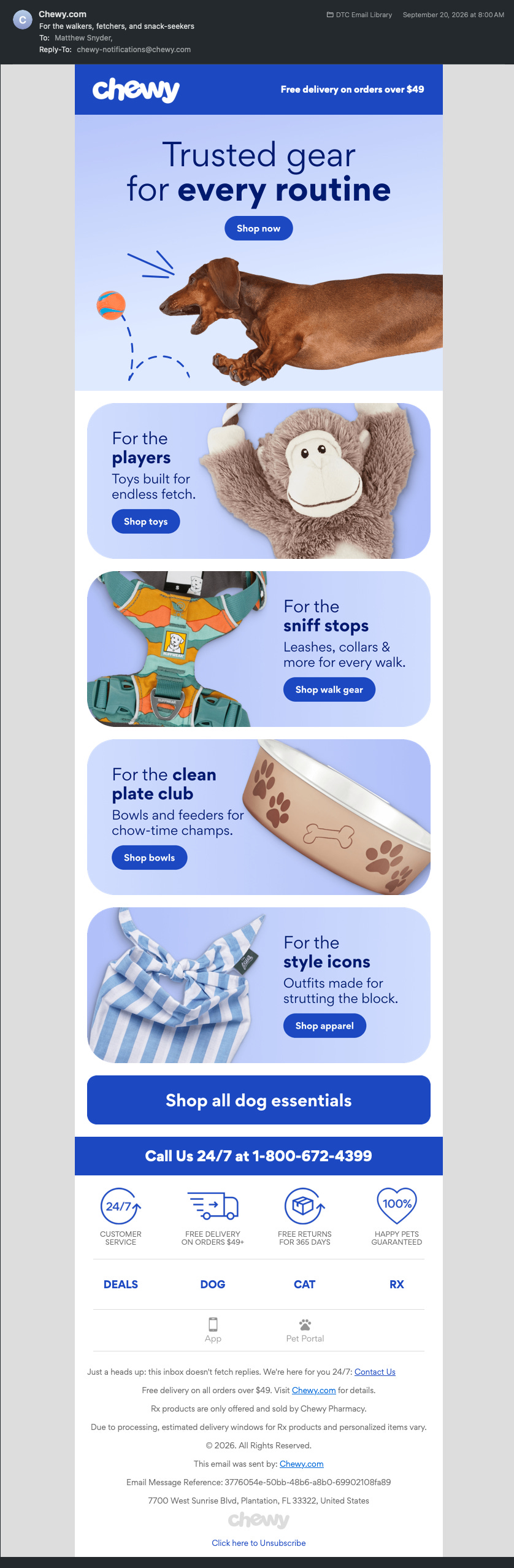
CHEWY
Format: Email
Why I like it: This is what I’d label an “evergreen email.” It can work any time of the year. But from the subject line to the category copy, it was packed with pet-driven personality. Loved it!
FLAMINGO ESTATE
Format: Email
Why I like it: “Take back your senses” and “No more optimization” and the “Smell a tomato” CTA all had me nodding my head. (P.S. there were several moving elements in this email, so be sure to view it here).

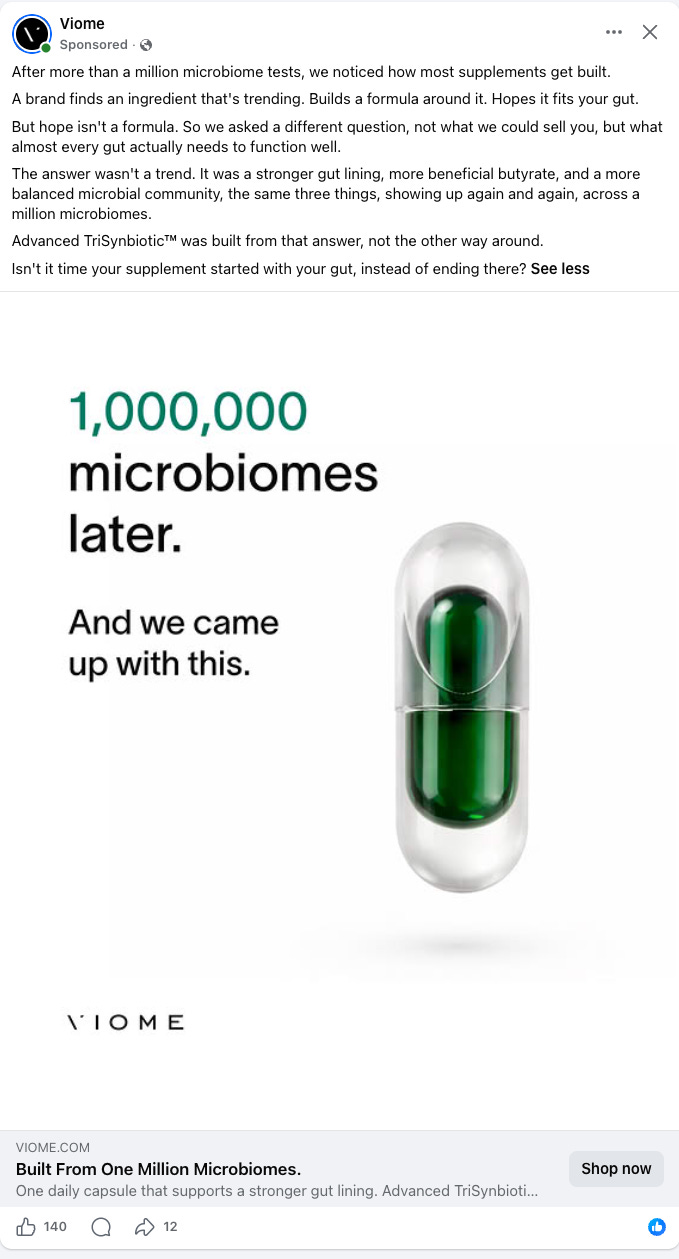
VIOME
Format: Facebook Ad
Why I like it: The way they leveraged whitespace to draw attention to their ‘breakthrough’ supplement. The primary text for the ad is great positioning too.
Job Opportunities
DTC Email Copywriter (Stimulate)
Copywriter (Patrick Ta Beauty)
Product Page Copywriter (SULLIVAN)
Copywriter, Credit Card (Snap Finance)
Direct-Response Ad Copywriter for Silvery (Ventura Brands Oy)
That’s it for this week! If you have questions or comments — drop a note below.
✌️
Matt
Are you new here? Thinking about subscribing? Here’s what else you can expect.