

Welcome to the 138th edition of the Weekly Round-Up — your once-a-week digest filled with copywriting insights, AI tips, must-read articles, pretty cool copy examples, and more!
In this week’s issue:
Copy Tip: Define Your Voice Pillars
AI Tip: Stop describing your voice. Show it.
The Email Problem You’re Not Seeing (via Sarah Fasuyi)
What Agencies Want from a Copywriting Agency (via Copywriter Collective)
Inside the creator economy’s AI reckoning (via HubSpot)
Video Pick: The 3-Step CTAs Formula for Conversion ****
Swipe File Additions
Job opportunities
This issue of the Weekly Round Up is brought to you by:
The Conversion Copy Operating System

The rules of copywriting contradict each other. That’s not an accident — it’s what happens when you learn tactics without the principles that govern them. The Conversion Copy Operating System fixes that.
👋 Interested in sponsoring an issue of the Weekly Round Up? Beginning this summer, I’m accepting select sponsorship opportunities. Click here for details.
Copy Tip of the Week
“Confident” is not a rule you can follow.
So, here’s what turns it into one…
Almost any copywriter can confirm that every “brand voice guide” has a word like this.
Confident.
Bold.
Playful.
Warm.
Whatever.
The problem? A word isn’t instructions.
Tell a writer “be confident” and they’ll apply their own interpretation to it.
The fix? Turn that “word” into a defined voice pillar.
A real Voice Pillar has three parts:
the word;
a definition
and a do/don’t
That’s what lets a writer actually WRITE from it, instead of guessing around it.
Let’s continue with our “confident” example.
On its own, the word is useless. But turn it into a pillar, and it looks like this:
Confident: States what’s true without hedging. Never apologizes for having a strong point of view.
Do: “This works. Here’s why.”
Don’t: “We think this could maybe help, depending on your situation.”
Now a writer isn’t guessing because they’ve got a test.
Does this line hedge? Cut the hedge.
A mood board tells a writer how the brand feels. A pillar tells them what to do about it.
That gap is the whole system.
Six lines like that – one per pillar – do more for a brand’s voice than a 3-page brand book full of adjectives ever will.
AI Insight of the Week
Stop describing your voice. Show it.
When you ask an AI to write “in your voice,” you’re handing it a vague brief.
“Conversational.”
“Punchy.”
“Less corporate.”
Those words don’t mean the same thing to the model that they mean to you — so it fills the gap with its own defaults, which is exactly why AI copy all sounds the same.
Instead of describing your voice, hand it a real edit.
Before: “We’re excited to announce our new feature that will help streamline your workflow and save you valuable time.”
After (your actual edit): “New feature. It saves you time. That’s it.”
Paste both into the chat and say “match this and do that going forward.” Now the model has something concrete to copy: where you cut words, how short your sentences run, what you swap in for corporate filler.
It’s still pattern-matching, you’re just choosing whether it matches your fuzzy adjectives or your actual sentences.
Must-Read Articles
The Email Problem You’re Not Seeing
(via Sarah Fasuyi)
Why I recommend it: (Not a traditional article, but a fantastic LinkedIn post). A wellness brand’s welcome flow looked broken — better copy, better segmentation, all the usual fixes checked out fine. So what was the fix? Sarah Fasuyi explains.
What Agencies Want from a Copywriting Agency
(via Copywriter Collective)
Why I recommend it: Half this agency’s briefs come from other agencies — and the client isn’t buying writing, they’re buying a name they can hand back their own reputation with no seam. Jack Stafford’s piece reframes the whole model: brands ask for three options, agencies ask for the one, because evaluating candidates costs them the thing they’re already shortest on — time.
Inside the creator economy’s AI reckoning
(via HubSpot)
Why I recommend it: Some brands are now writing contracts that require creators hand over their AI prompts along with the finished work — and creator-rights consultant Kameron Buckner’s answer is a flat no, because the prompting process is where the actual thinking lives, not the output. Expect that fight to show up in freelance contracts generally, not just creator deals.
Podcast/Video Pick of the Week
The 3-Step CTAs Formula for Conversion (via NN/Group)
Why I recommend it: Most weak CTAs aren’t a design problem — they’re just missing a step. Taylor Dykes breaks the formula into three parts: an actionable verb, a clear signal of what happens next, and a stated payoff for clicking, which is why “Learn More” underperforms and “Get your custom price in 30 seconds” doesn’t.
Pretty Fly Copy
🔓 Want access to my entire swipe file database?
Subscribe here to unlock the magic link.
AUTODESK
Format: Billboard
Spotted By: Cole Schafer
Why I like it: Real world meets imaginary world 🤝

HEART & SOIL
Format: Email
Why I like it: Great education-based email campaign for problem-aware customers. It explains the why and then offers a solution. Super basic, but quite effective.

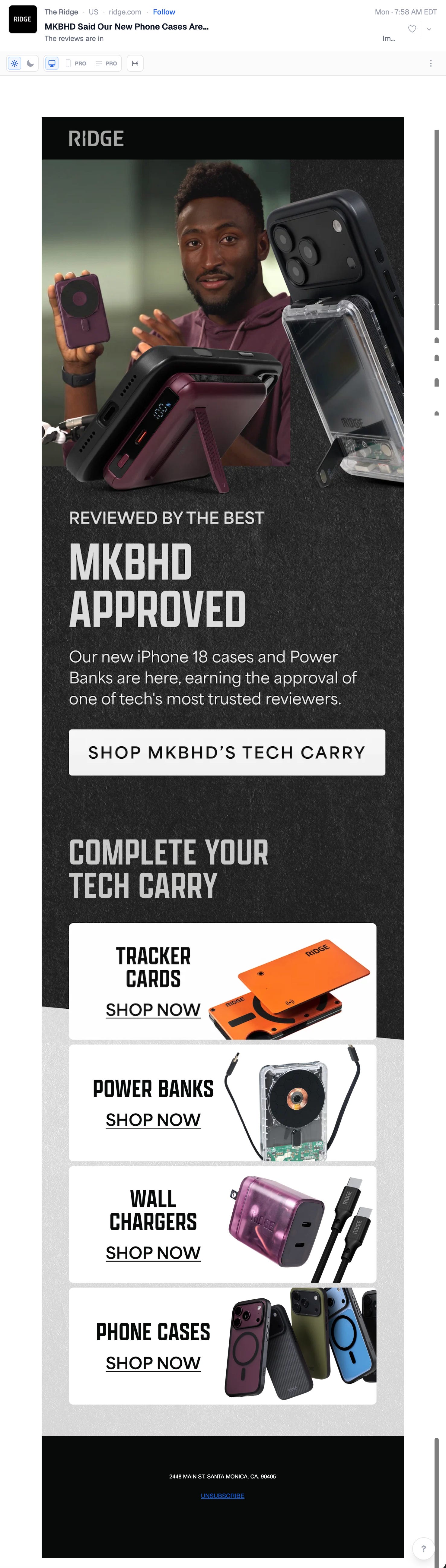
RIDGE
Format: Email
Why I like it: Loved the subject line. Very curious.
Job Opportunities
Credit Repair Conversion Writer (Compose.ly)
Conversion and Growth Copywriter (CRO Metrics)
Marketing Content Strategist (Alignerr)
Senior Copywriter – on call (Tailored Brands)
Content & Brand Editorial Lead (Pindrop)
That’s it for this week! If you have questions or comments — drop a note below.
✌️
Matt
Are you new here? Thinking about subscribing? Here’s what else you can expect.