

Welcome to the 136th edition of the Weekly Round-Up — your once-a-week digest filled with copywriting insights, AI tips, must-read articles, pretty cool copy examples, and more!
In this week’s issue:
Copy Tip: Guessing vs. Listening
AI Tip: Give your claims proof
Your Brand Now Has a Second Audience: The AI Machines (via Matchstic)
Why Your Best Content Strategy Is Subtraction
(via Content Marketing Institute)The problem with potential (via Around the Bonfire)
Podcast Pick: 5 Pop-Up Tactics That Can Increase Your Lead Opt-in Rate
(via Brain Driven Brands)Swipe File Additions
Job opportunities
This issue of the Weekly Round Up is brought to you by:
The Conversion Copy Operating System

The rules of copywriting contradict each other. That’s not an accident — it’s what happens when you learn tactics without the principles that govern them. The Conversion Copy Operating System fixes that.
👋 Interested in sponsoring an issue of the Weekly Round Up? Beginning this summer, I’m accepting select sponsorship opportunities. Click here for details.
Copy Tip of the Week
Copy doesn’t fail because of bad writing.
It fails because someone GUESSED instead of LISTENED.
You don’t have to imagine what your audience thinks – they’re already telling you, in their own words, somewhere you’re probably not looking.
Start with the four-star reviews, not the five-star ones. Five stars are often too polished, sometimes fake. Four stars are where people actually explain themselves.
Then read your support tickets. That’s frustration typed in real time, before anyone’s had the chance to sound smart about it.
Pull sales call transcripts if you have them. The exact phrase someone uses right before they say yes (or don’t) tells you more than anything you could invent.
And check Reddit. People complain to strangers there the same way they’d complain to a friend.
Pull from at least three of these before you write a single line. One source is a hunch. Three? Three is a pattern.
Once you’ve drafted something, read it back and ask: does this sound like a marketer, or like someone who’s actually lived the problem?
If it’s the former, go back to the source material.
Customer language, arranged well, beats clever every time.
AI Insight of the Week
Go through your last post and circle every claim. Not just the big one in the headline. All of them, tucked into sentences you didn’t think twice about.
Now look at what’s sitting next to each one.
Most claims don’t have proof nearby. They have more claims. “This works” backed by “and it works well” is just the same sentence in a different shirt.
You don’t catch this while you’re writing because you already believe every claim you’re making. The gap between an assertion and a proven claim only shows up to someone who wasn’t convinced walking in.
Claude wasn’t.
Paste your draft in and ask it to list every claim you’re making, then ask which ones don’t have a proof element sitting nearby: a number, an example, a name, a credential, a result.
You’ll get back a short list. That list is exactly where your reader’s trust breaks.
The fix is simple. Sit a stat next to the claim it supports. Swap a general result for a specific one, and swap “clients” for a name. Proof has to sit close enough that a skimmer catches both in the same glance.
Put proof next to the claim it’s supposed to support, and the copy stops asking for trust it hasn’t earned yet.
Must-Read Articles
Your Brand Now Has a Second Audience: The AI Machines
(via Matchstic)
Why I recommend it: This one reframed something for me: if your brand voice is defined by adjectives — “confident,” “human,” “bold” — you’re leaving blanks for AI to fill, and it fills them generically, at scale, across every output your team produces. Blake Howard at Matchstic argues the fix isn’t better prompts (which only last as long as a single session); it’s translating your guidelines into explicit do/don’t rules a machine can execute without guessing.
Why Your Best Content Strategy Is Subtraction
(via Content Marketing Institute)
Why I recommend it: Robert Rose at CMI makes a case I hadn’t heard put this cleanly: the quantity vs. quality debate is just an argument about addition speed — nobody in either camp gets promoted for removing anything. He cites a University of Virginia study showing humans reach for additions even when subtraction is the better fix; given a wobbly Lego bridge, people add blocks. His fix is a recurring “kill call” where your team argues existing assets to keep, merge, or retire — and it doubles as the best judgment-training exercise a content team can run.
The problem with potential
(via Around the Bonfire)
Why I recommend it: Shannon Deep at Around the Bonfire puts language to something I’ve been sitting with since launching Real People: potential, as most people define it, is just production with better PR. You’re not meeting your potential by being content, or building something intentionally small — you’re meeting it by generating something external and measurable that other people validate. The question she’s really asking is: what are you maximizing for, and WHO decided that?
Podcast/Video Pick of the Week
5 Pop-Up Tactics That Can Increase Your Lead Opt-in Rate
(via Brain Driven Brands)
🎧 Listen on iTunes | Listen on Spotify
Why I recommend it: Showing a pop-up twice doesn’t kill conversion rate — it nearly doubles opt-ins. The founder of Alia (recently acquired) breaks down “smart triggering”: showing a pop-up at second 5, again at product page scroll, again before exit — so the discount stays anchored in the visitor’s mind through the decision. The even better find: “mystery discount” outperforms 20% off on opt-in rate while only giving 10%, which means you’re buying the same psychology for half the margin cost.
Pretty Fly Copy
🔓 Want access to my entire swipe file database?
Subscribe here to unlock the magic link.
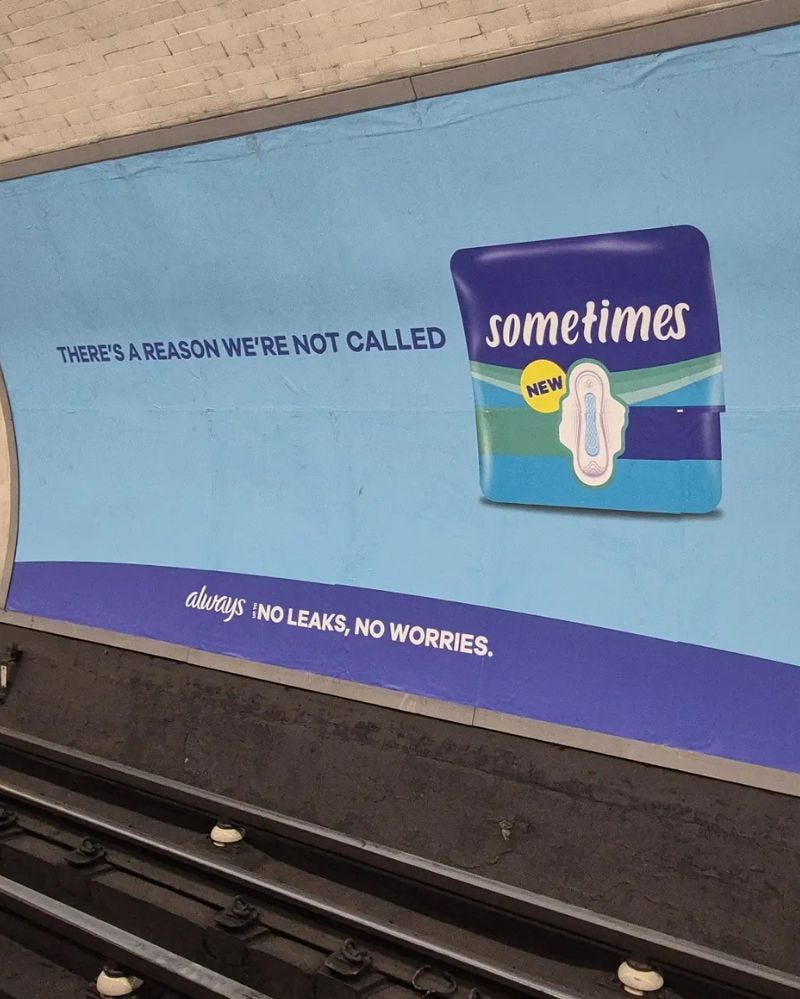
ALWAYS
Format: Billboard
Spotted By: Richard King
Why I like it: Copywriters just want to have fun… always.
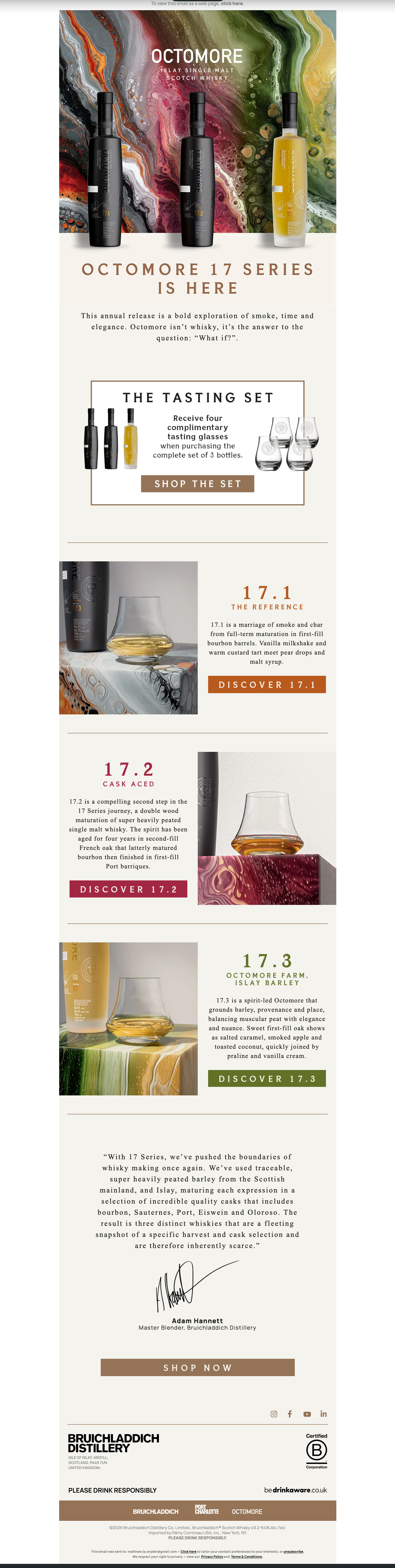
BRUICHLADDICH
Format: Email
Why I like it: A beautifully designed email, but also a great collection launch. What’s great about it isn’t just the email, but the PDPs (17.1 example here). They do a fantastic job complementing the email campaigns, particularly in describing what makes the whisky truly unique. (Also, I really want this.)
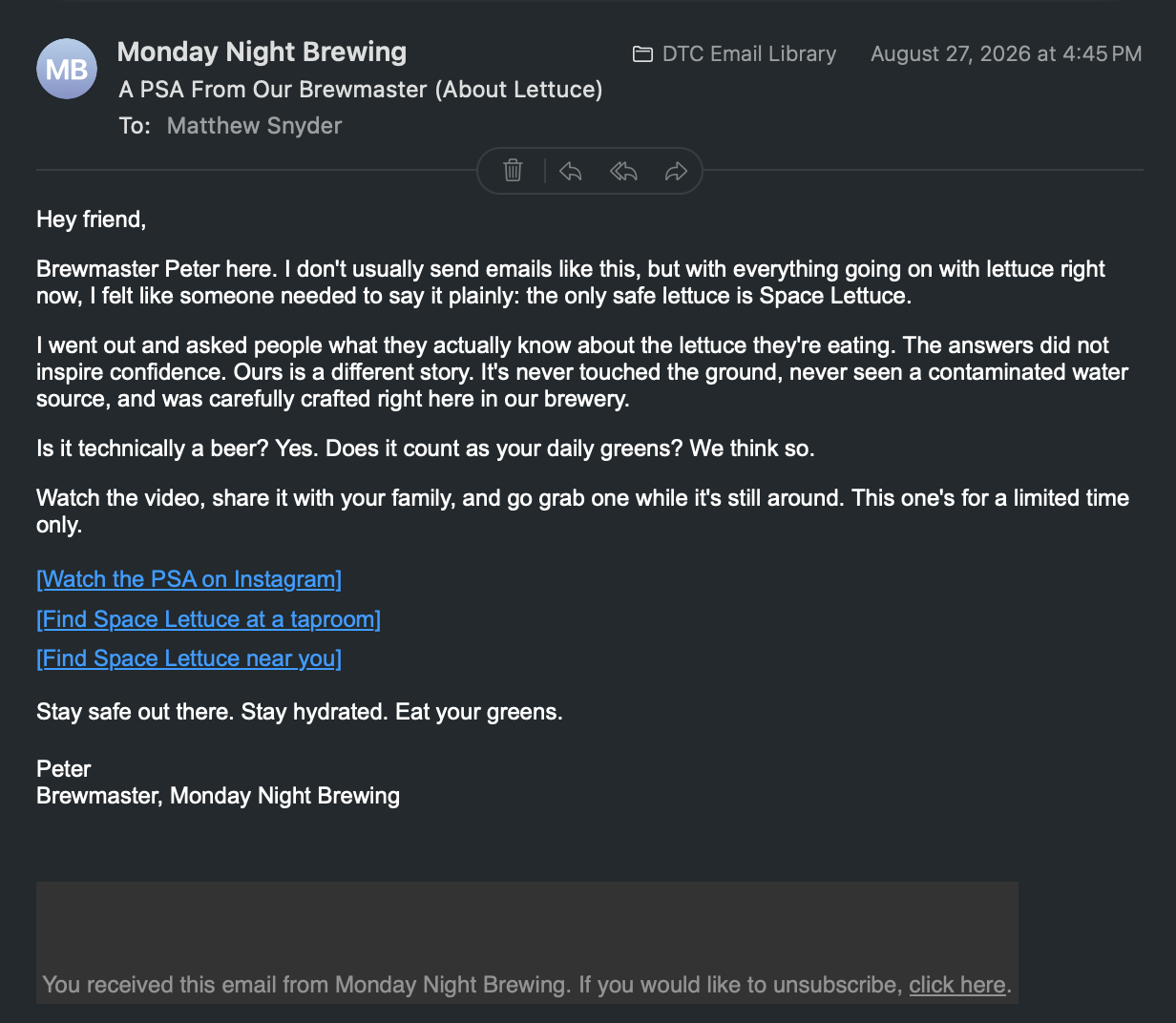
MONDAY NIGHT BREWING
Format: Email
Why I like it: I love it when brands seize a moment. In this case, MNB (a local brewery here in Atlanta) took advantage of the questions surrounding… lettuce.. and wrote an email akin to the food safety problems and how it was of no concern to their beer, Space Lettuce. MORE OF THIS, FAM.
Job Opportunities
That’s it for this week! If you have questions or comments — drop a note below.
✌️
Matt
Are you new here? Thinking about subscribing? Here’s what else you can expect.