


Welcome to the 132nd edition of the Weekly Round-Up — your once-a-week digest filled with copywriting insights, AI tips, must-read articles, pretty cool copy examples, and more!
In this week’s issue:
Copy Tip: The Believability Test
AI Tip: The Awareness Audit
[Fundamentals] How to share your point of view (even if you’re afraid of being wrong) (via Wes Kao)
The psychology of the inbox: designing emails for tired brains (via Action Rocket)
How Much Creative Debt are You Carrying? (via Around the Bonfire)
Video Pick: If You Only Watch One Business Video, Make It This (via Will Barron)
Swipe File Additions
Job opportunities
This issue of the Weekly Round Up is once again brought to you by:
The Conversion Copy Operating System

The rules of copywriting contradict each other. That’s not an accident — it’s what happens when you learn tactics without the principles that govern them. The Conversion Copy Operating System fixes that.
👋 Interested in sponsoring an issue of the Weekly Round Up? Beginning this summer, I’m accepting select sponsorship opportunities. Click here for details.
Copy Tip of the Week
Most copy fails the same test – the “believability test.”
What is it?
Well, read any line of the copy you just wrote and ask if your competitors could say the exact same thing about their product.
If they can, bad news. You’re not writing copy at that point, you’re just writing “category filler.”
Instead of the basics like “save time” or “grow your business” or “feel better,” try to be more specific:
Save 17 minutes every morning
Add $4,200/mo. in recurring revenue
Wake up without the 3pm crash
That specificity communicates the same idea, but with a completely different effect.
Why does this work?
Well, our brains treat specificity as PROOF. Vague claims sound like marketing and your guard’s immediately going up. Specificity, however, sounds like fact.
And your proof doesn’t actually have to be dramatic (although it should at least be true). But that precision is what sells.
So, take something you’ve written (it could already be up on your website or in an email), and ask yourself: Could a competitor steal this word for word?
If the answer’s yes, then sit down and fix it with a number, a name, or a detail only YOU could claim.
(Or don’t. Your call.)
AI Insight of the Week
You know your product too well to write to someone who doesn’t.
You’ve spent months inside your product.
You know the mechanism and you know why it works, but your reader doesn’t.
They’re still stuck on the problem and you’re three steps past it.
You write to the person you’ve become instead of the person reading you.
The sentences are fine, but it’s the gap that’s the issue.
This is one of the rare places AI can beat you at your own job. You’re too close to your product to see where you skipped ahead. Thankfully(?), Claude isn’t.
Try this:
Paste your draft into Claude.
Tell it exactly where your reader is right now. Problem-aware. Solution-aware. Somewhere in between.
Then give it one instruction: “Flag every line that assumes more awareness than this reader has.”
Not “make this better.”
Not “give me feedback.”
One lens, one pass.
You’ll get back the exact lines where you talked past your reader instead of meeting them.
Fix those and the post you already wrote starts landing the way you meant it to.
Must-Read Articles
[Fundamentals] How to share your point of view (even if you’re afraid of being wrong) (via Wes Kao)
Why I recommend it: Staying silent feels safe, but if you’re the person closest to the problem, you might be the only one who can connect the dots — and holding back robs your team of that. Wes Kao’s six principles for sharing your point of view with confidence: show your reasoning, calibrate your certainty, and let the idea stand on its own without leaning on your credentials.
The psychology of the inbox: designing emails for tired brains (via Action Rocket)
Why I recommend it: Your subscribers aren’t ignoring your emails because they’re disinterested — they’re ignoring them because they’re exhausted. Written on a delayed train after receiving 18 brand emails in four hours, Molly Kayll’s key argument is that the future of email isn’t more personalization, it’s better judgment – knowing when not to send is now a competitive advantage.
How Much Creative Debt are You Carrying? (via Around the Bonfire)
Why I recommend it: Every time you say “I’ll get back to that creative project when things settle down,” you’re taking out a loan against your future creative self, and unfortunately, that interest compounds. Shannon Deep’s framework for paying it down: stop calculating ROI on creative work, make automatic payments (recurring containers of time), and know which unfinished project haunts you most (because that’s the one accruing the highest psychological interest).
Podcast/Video Pick of the Week
WILL BARRON
If You Only Watch One Business Video, Make It This
Why I recommend it: Most service business owners lose deals not because their service isn’t good enough, but because they pitch before they diagnose. Will Barron’s five-step framework covers the whole process — from mapping the “reality gap” (current pain to desired outcome) on discovery calls, to the two-sentence micro close that forces a yes or no without sounding like a sleazy salesperson. Useful for anyone who sells anything, even if your “product” is your own creative work.
Pretty Fly Copy
🔓 Want access to my entire swipe file database?
Subscribe here to unlock the magic link.
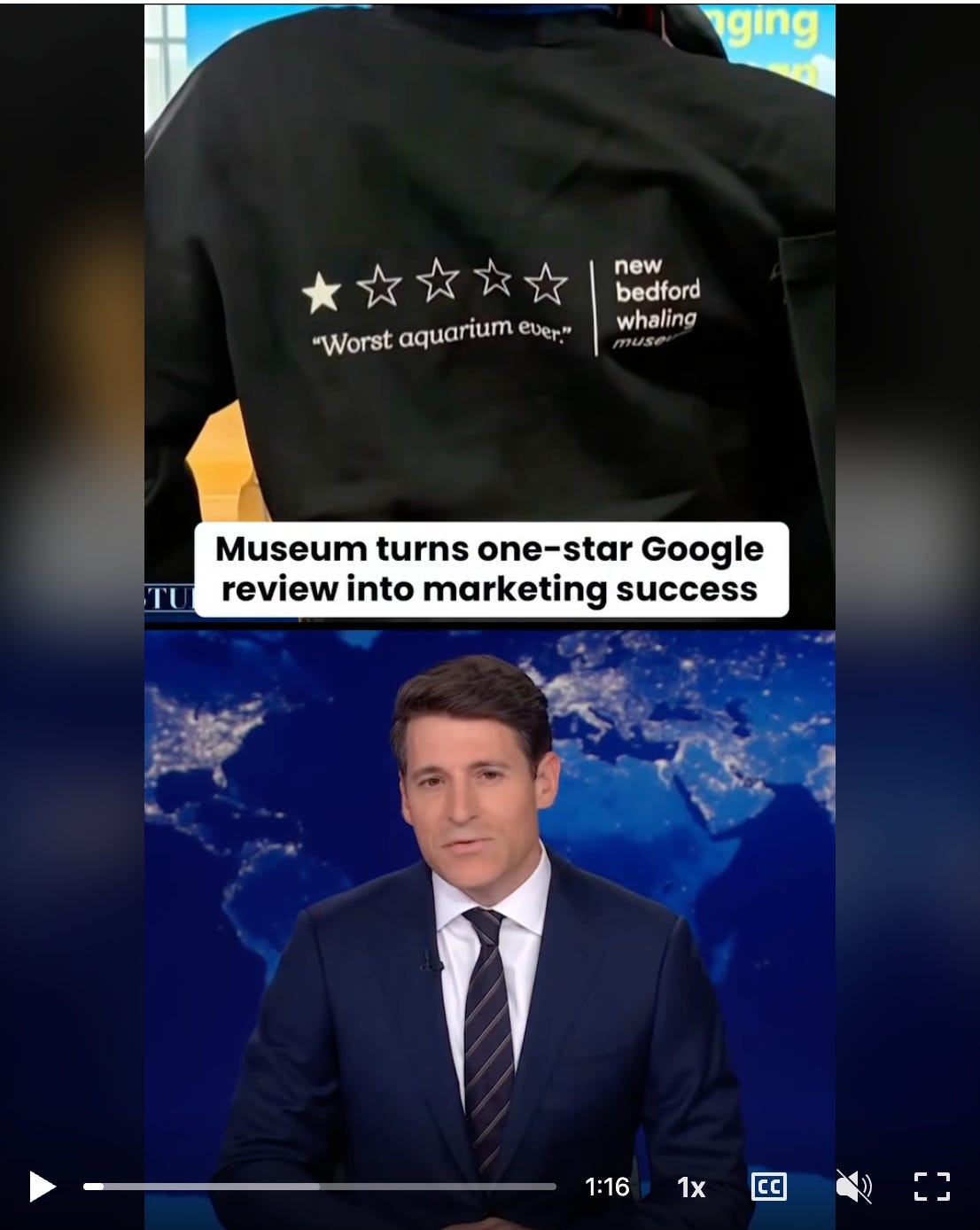
Bedford Whaling Museum
Format: Ad
Spotted By: Jason Feifer
Why I like it: I’ve seen this type of campaign angle take off before (using 1-star reviews), but not at this level. Mad props to the team at BWM for owning who they are!
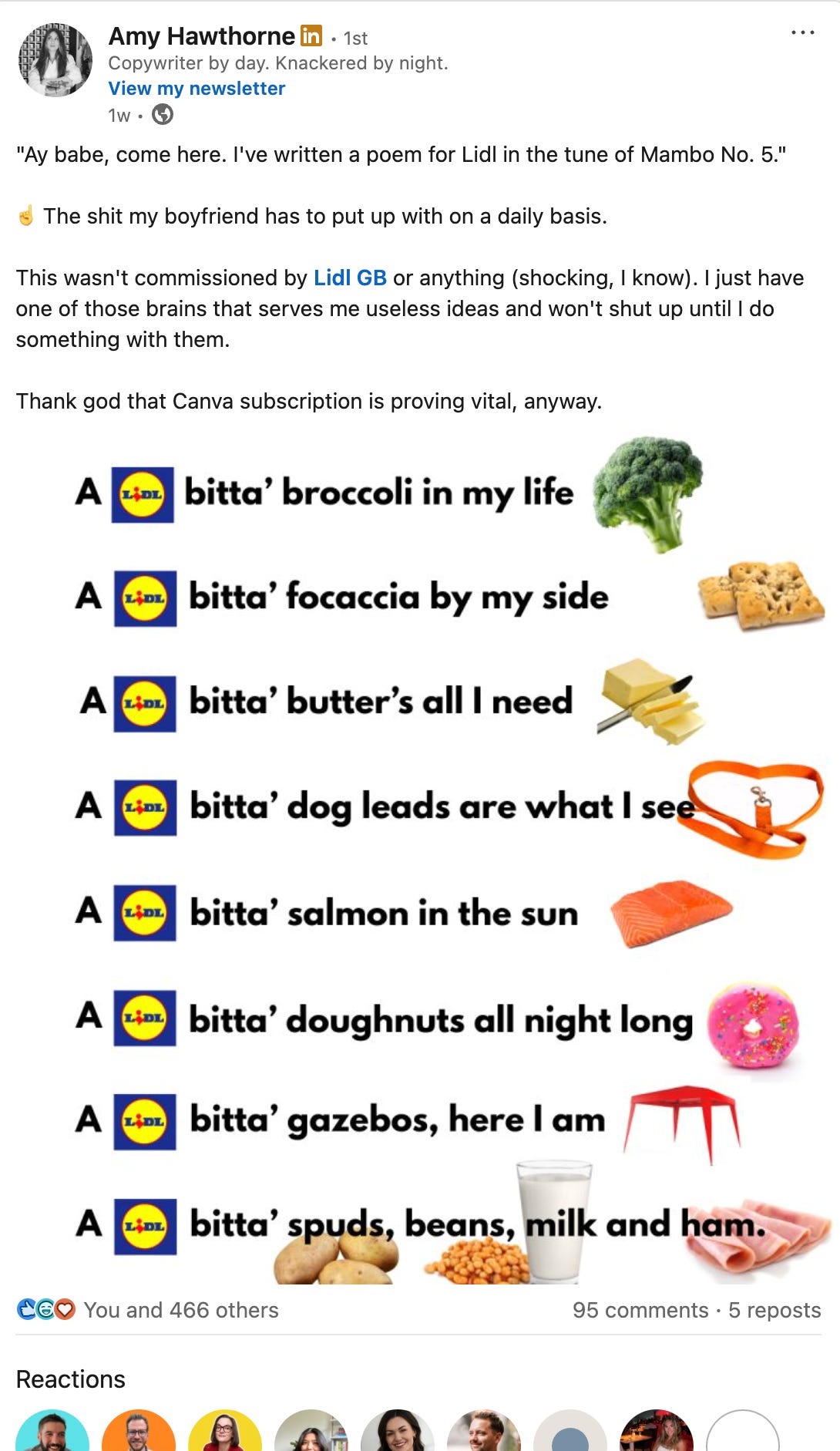
LIDL
Format: Ad?
Spotted By: Amy Hawthorne
Why I like it: While this wasn’t a true Lidl ad, it was an amazing spec piece from Amy Hawthorne. I hope Lidl picked it up (love that grocery chain, btw).
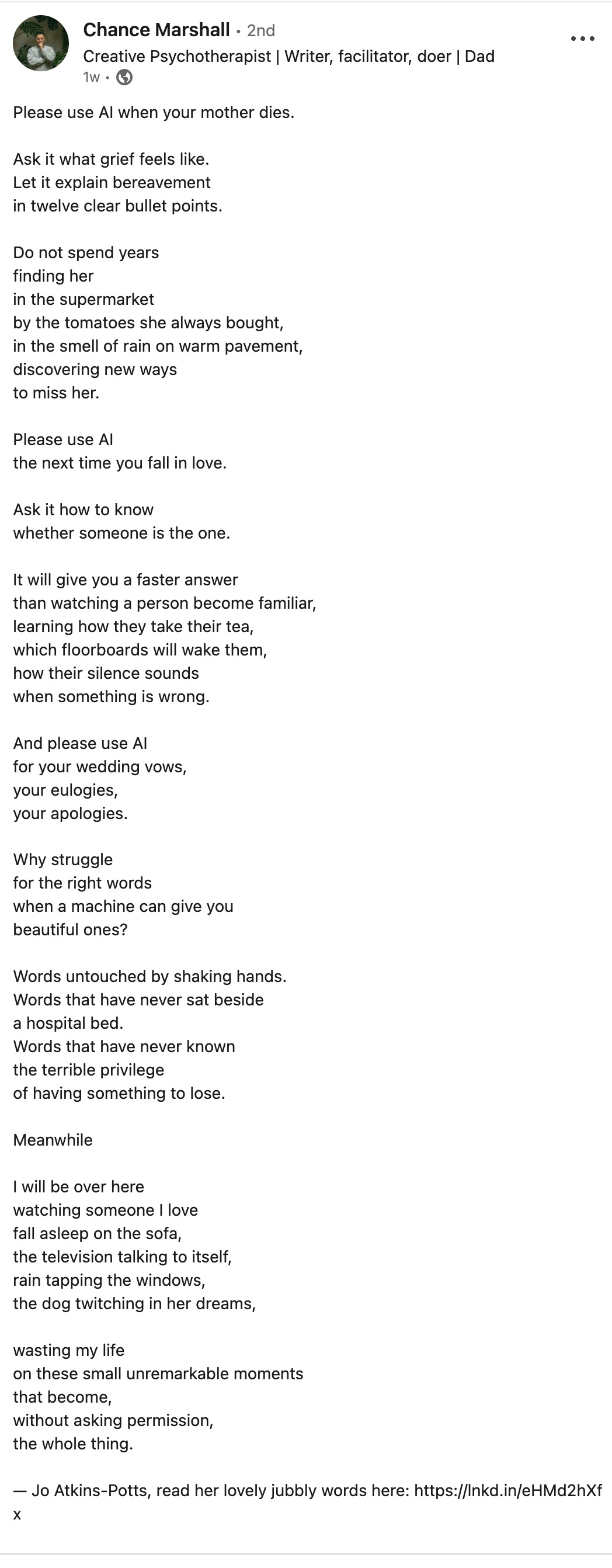
Jo Atkins-Potts
Format: Poem
Spotted By: Chance Marshall
Why I like it: Sometimes inspirational copy isn’t an ad or a landing page or a video or an email – sometimes it goes back to the basics: poetry. Loved this reflection that Chance Marshall shared from Jo Atkins-Potts.
Classifieds
Job Opportunities
That’s it for this week! If you have questions or comments — drop a note below.
✌️
Matt
Are you new here? Thinking about subscribing? Here’s what else you can expect.