


Welcome to the 131st edition of the Weekly Round-Up — your once-a-week digest filled with copywriting insights, AI tips, must-read articles, pretty cool copy examples, and more!
In this week’s issue:
Copy Tip: The 3 C’s of Story
AI Tip: Save the horsepower for where it actually moves the needle.
The Revision Where Good Work Goes to Die (via Copywriter Collective)
Why the Rule of 3 Makes You a Better Communicator (via INC)
Marketing needs AI outcomes, not more AI pilots (via MarTech)
Principles Over Pressure: Sticking To Your Values During Mid-Year Sales Pushes (via The Copy Minimalist)
Podcast Pick: Choose the Right Channel: How Stanford Finds Its Voice
Swipe File Additions
Job Opportunities
This issue of the Weekly Round Up is brought to you by Shlomo Genchin:
CopyTemplate

My friend Shlomo just launched CopyTemplates ($97) – a library of 63 proven copywriting techniques, each comes with handpicked examples (500+ in total), plus 70+ copy-paste AI prompts and Claude skills.
It’s the best resource I’ve seen for writing headlines, with or without AI.
👋 Interested in sponsoring an issue of the Weekly Round Up? Beginning this summer, I’m accepting select sponsorship opportunities. Click here for details.

Copy Tip of the Week
Every story that sells has the same skeleton:
Character
Conflict
Change
Strip away the branding, the product, the channel — every story that actually moves someone has all three. Remove any one, and the whole thing collapses.
Character: someone the reader recognizes. Could be a customer, a founder, a version of themselves.
Conflict: the thing standing in their way. Without tension, there’s no reason to keep reading.
Change: what’s different now. No change, no point.
Most “brand stories” only have one or two of these. They introduce a character, skip the real conflict, and jump straight to “and now we’re great.”
But that’s not a story. There’s no depth.
If you want your story to actually sell, give the reader all three – especially the conflict! It’s the part everyone’s most tempted to cut, but it’s almost always the part doing the most work.
AI Insight of the Week
Use your most powerful model for the first draft. Switch to a simpler one for iteration.
Most people pick a model and stay on it for the whole task, but that’s backwards.
The first draft is where the real thinking happens — structure, angle, the core argument. That’s the part you want your strongest model on. Get the hardest cognitive work done up front, when the stakes for quality are highest.
But once the draft exists, the work changes. You’re tightening lines, adjusting tone, trying variations. That’s lighter lifting, and a faster, cheaper model handles it just as well (and often faster, which matters when you’re iterating quickly).
So my advice? Front-load the intelligence. Save the horsepower for where it actually moves the needle.

Must-Read Articles
The Revision Where Good Work Goes to Die (via Copywriter Collective)
Why I recommend it: “The first script was the best thing I’ve written in two years,” a writer told Jack Stafford. “What ran was the seventh.” Stafford breaks down where great work actually dies and why “make it pop” is a confession, not feedback. The job of protecting an uncomfortable idea long enough for it to prove itself isn’t the creative’s. It’s yours.
Why the Rule of Three Makes You a Better Communicator (via INC)
Why I recommend it: A tripod is stable in a way a four-legged stool never quite is, and the same principle governs why your audience remembers three points and forgets seven. Andrea Wojnicki breaks down the cognitive science behind the rule of three, plus the twist: AI has been flagged for overusing it, but the science was true long before any algorithm caught on…
Marketing needs AI outcomes, not more AI pilots (via MarTech)
Why I recommend it: Many marketing teams now have more AI activity than AI value. Nicole Greene (Gartner) makes the case for managing AI like a portfolio across three tiers — defend (efficiency), extend (better outcomes), and upend (new capabilities) — instead of chasing whatever pilot looks shiny next.
You Should Read This Too:
Principles Over Pressure: Sticking To Your Values During Mid-Year Sales Pushes

New here? Consider subscribing to never miss when new issues drop!

THINK FAST TALK SMART
Ep. 299: Choose the Right Channel: How Stanford Finds Its Voice
🎧 Listen on iTunes | Listen on Spotify
Why I recommend it: Stanford’s VP of communications runs every story through one question before a single word gets written: short video, longform, or media pitch — and sometimes the answer is “let a journalist tell it, not us.” Farnaz Khadem breaks communication down to three things: know your goal, know your audience, know your data, plus a crisis-comms rule worth stealing. Anybody who communicates should listen to this!

🔓 Want access to my entire swipe file database?
Subscribe here to unlock the magic link.
Pretty Fly Copy
HOWLER BROTHERS
Format: Email
Why I like it: If there’s a killer/fun story behind your product – share it! I actually own this shirt and I didn’t know the legend behind it. Honestly, pretty damned cool.

SEED
Format: Email
Why I like it: The subject line leaves me wanting, but the guts of the email (pun intended?) are fantastic for someone who’s product aware and looking for a reason to switch. It pulls all the social proof levers.

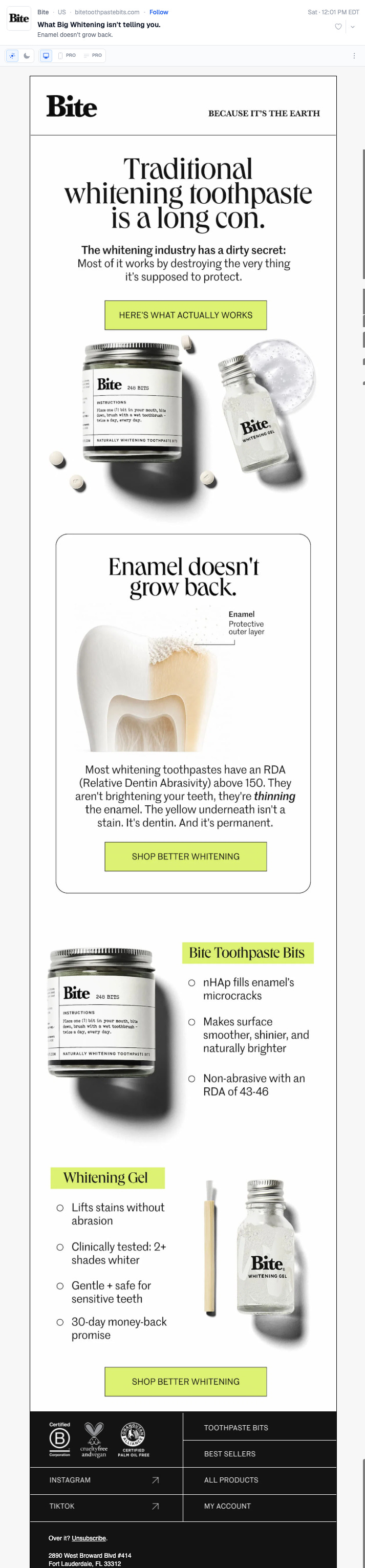
BITE
Format: Email
Why I like it: A great example of the PAS copy framework at play. And honestly, more CPG/wellness/supplement brands should do this.
Classifieds
Job Opportunities
Senior Copywriter (Tilt)
Remote
That’s it for this week! If you have questions or comments — drop a note below.
✌️
Matt
Are you new here? Thinking about subscribing? Here’s what else you can expect.