


Welcome to the 112th edition of the Weekly Round-Up — your once-a-week digest filled with copywriting insights, AI tips, must-read articles, pretty cool copy examples, and much more!
In this week’s issue:
Copy Tip: Logic vs. Emotion
AI Tip: AI is a compression engine, not an expansion tool
BLUF: The Military Standard That Can Make Your Writing More Powerful
Why Copywriting is the New Superpower in 2026
Companies aren’t looking for storytellers. They’re looking for meaning.
Podcast Pick: Trust, Timing, and Email Touchpoints with Mike Nelson of Really Good Emails
Swipe File Additions (Wrinkles Schminkles, Windsor Canadian, Mars Men, Hollow)
Job Opportunities

Copy Tip of the Week
People like to believe they make buying decisions logically.
They don’t.
Logic usually shows up AFTER the decision has already been made.
It’s there to explain a choice, not to create it.
What actually drives action is emotion.
Before anyone compares features or reads testimonials, they feel something.
Frustration with how things are. A pull toward how things could be. Relief at the possibility that this might finally be the answer.
That feeling is what earns attention. That feeling is what “gets the click” and keeps someone moving down the page.
Once that desire is there, logic steps in and people start looking for reasons.
Specs, proof, ROI, social validation, etc.
Not because those things create the want, but because they help justify it. Logic makes the decision feel responsible.
Then, at the moment of purchase, emotion takes over again.
No one checks a spreadsheet right before they click “buy.” They check in with themselves.
Does this feel safe?
Does this feel exciting?
Does this feel like the right move?
If the answer isn’t clear, they hesitate and leave.
That’s why so much copy underperforms.
It leads with logic, explains too early, and asks people to care before giving them a reason to.
Better copy does the opposite.
It meets people in the feeling they already have. It names the tension. It points to the outcome they want and the gap they’re stuck in.
Then, once they’re leaning in, it gives them the proof they need to feel good about saying yes.
Emotion opens the door.
Logic supports the decision.
Emotion closes it.
Get that sequence right, and the rest gets a lot easier.
AI Insight of the Week
AI is a compression engine, not an expansion tool
Most people use AI to create more.
More ideas.
More options.
More words.
More output.
And then they wonder why everything still feels noisy.
The real leverage with AI is compression.
High-quality work doesn’t come from adding.
It comes from removing.
Instead of asking AI to generate, ask it to collapse what you already have.
Use it to:
Reduce messy strategies into first principles
Shrink ten ideas down to the one that actually matters
Strip work to the few inputs that drive most outcomes
For example.
Instead of:
“Give me 10 campaign ideas.”
Ask:
“Given these 10 ideas, which one carries the highest upside and why?”
Instead of:
“Help me improve this plan.”
Ask:
“What is unnecessary, distracting, or low-leverage in this plan?”
Instead of:
“Rewrite this to be better.”
Ask:
“What can be removed without hurting the outcome?”
What comes back isn’t exciting.
It’s clarifying.
And clarity is the multiplier.
Compression forces tradeoffs.
Tradeoffs force decisions.
Decisions are what move work forward.
AI doesn’t replace taste or judgment.
It exposes where you haven’t used them yet.
So, before you ask AI to help you do more, ask it to help you do less, better.

Must-Read Articles
BLUF: The Military Standard That Can Make Your Writing More Powerful
🔗 https://www.animalz.co/blog/bottom-line-up-front
Why I recommend it:
Breaks down the “bottom line up front” writing approach — a simple but powerful way to lead with your most important point in emails and other copy so readers instantly get what matters and act faster.
Why Copywriting is the New Superpower in 2026
🔗 https://searchengineland.com/why-copywriting-is-the-new-superpower-in-2026-467281
Why I recommend it:
Well, I’m biased. But also this makes the case that in 2026 the real leverage isn’t traffic volume but sharp, persuasive copy — the kind that actually moves people, not just ranks in a search result — and reminds us that honing those human-first skills is how we stay valuable even as AI floods the space.
Companies aren’t looking for storytellers. They’re looking for meaning.
🔗 https://martech.org/companies-arent-looking-for-storytellers-theyre-looking-for-meaning/
Why I recommend it:
This flips the “storytelling” conversation by pointing out that what companies really crave isn’t pretty narratives but meaning — clear, context-rich messaging that helps people understand why your brand matters, which is exactly the kind of mindset that can make your creative more purposeful and effective.
You Might Also Like:
How to Audit and Clean Up Copy Without Rewriting Everything

Why January Is the Right Time to Clean Your Copy

HAPPY SUBSCRIBERS
Trust, Timing, and Email Touchpoints with Mike Nelson of Really Good Emails
🎧 Listen online
Why I recommend it:
This is a masterclass on why email still works—and how to use it without burning out your list.
The big idea: trust isn’t built in one email. Most subscribers need multiple touchpoints before they click, reply, or buy. That’s why your welcome sequence matters, why consistency beats sporadic blasts, and why email should be treated as a relationship-building channel—not just a traffic lever.
They cover what metrics actually matter (hint: replies and downstream behavior > opens), how frequency can increase trust when done thoughtfully, and how to balance value-first emails with smart, well-timed asks.
If you’ve ever wondered how often to send, how to keep subscribers engaged, or how email fits into long-term growth—not just short-term clicks—this one’s worth your time.

🔓 Want access to my entire swipe file database?
Subscribe here to unlock the magic link.
Pretty Fly Copy
WRINKLES SCHMINKLES
Format: Email
Spotted by: Filip Pejic
Why he recommends it: Simply a great hero.

WINDSOR CANADIAN
Format: Ads
Spotted by: Shlomo Genchin
Why he recommends it:
“But does it have legs?”
My first teacher at Miami Ad School taught me that most ad ideas are just one-offs.
They only have one headline. One visual. One execution.
So even if the ad is great, its impact is... pretty limited.
Concept ads are different.
They’re scalable: One execution can turn into five.
They’re fluid: A static ad can turn into a video, a tweet, or even a PR stunt.
They’re contagious: Instead of looking for flaws, clients suggest more angles.
Here’s one of my favorite ad concepts ever: It definitely has legs :)

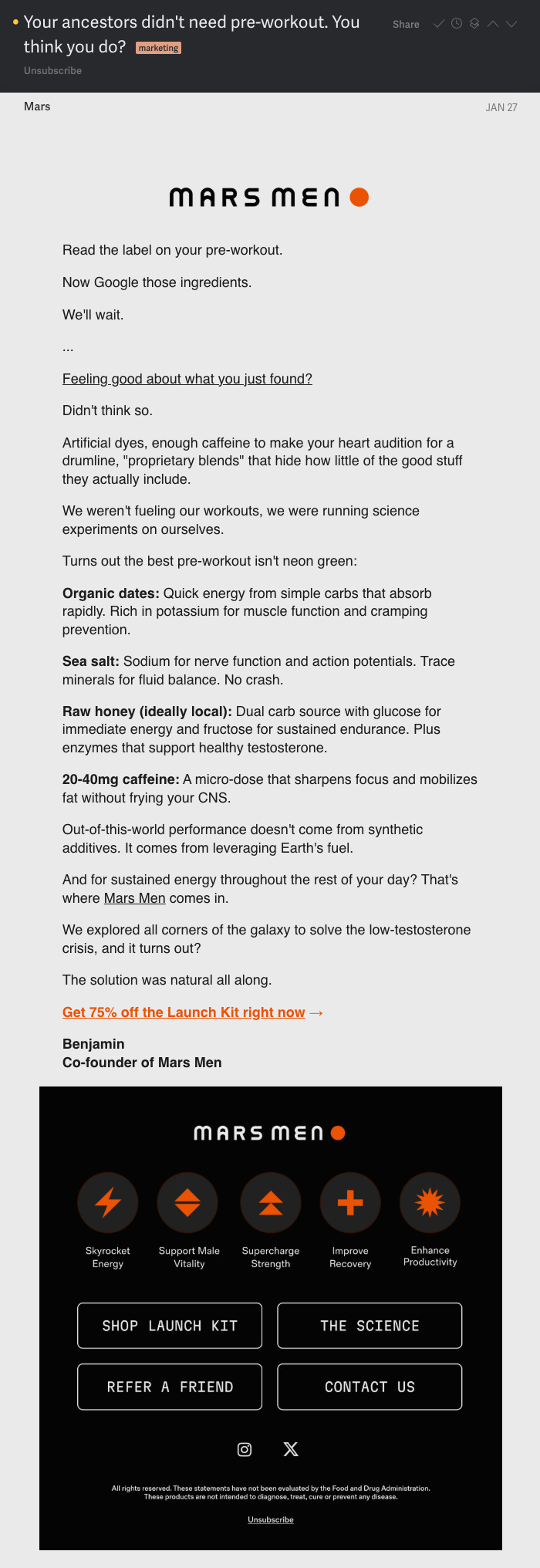
MARS MEN
Format: Email
Why I recommend it: A great way to capture your audience’s attention is to call out (and dismantle) a limited belief masked as a truth. In this case, it all had to do with the need for pre-workout. Their argument then positions their product as a great natural alternative to performance-based synthetic drugs.
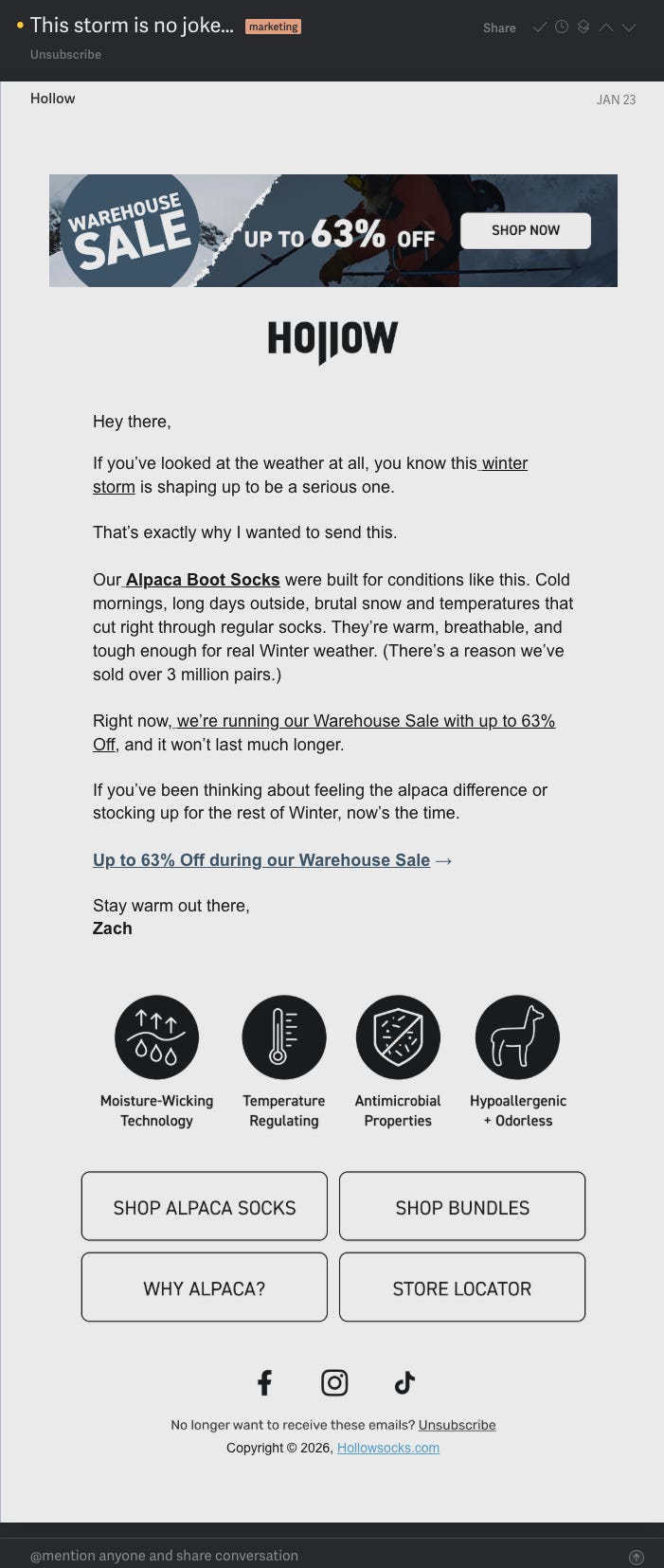
HOLLOW
Format: Email
Why I recommend it: We’ve said it before and we’ll say it again: personalization is so much more than “first name” tags. This is a great example of framing a product (and sale) in light of a major weather event that cut across the States. Major props!

Career Opportunities
These remote opportunities are updated every week with copywriting and marketing roles ambitious job-seekers should definitely apply for.
Senior Copywriter at Upstart
📍Remote ℹ️ Fintech 💸 $103,000 - $143,000 (USD)
Email Copywriter & Content Strategist (Part-time) at Join Marathon
📍Remote ℹ️ Agency 💸 $30/hr (USD)
Copywriter III at Blackstone Talent Group
📍Remote ℹ️ B2B 💸 Not Listed
Senior Performance Copywriter at Cleo
📍Remote ℹ️ Fintech 💸 $78,000 - $95,000 (USD)
Lifecycle Copywriter at Alpha Lion
📍Remote ℹ️ B2C 💸 $70,000 - $90,000 (USD)
That’s it for this week! If you have questions or comments — drop a note below.
✌️
Matt
Are you new here? Thinking about subscribing? Here’s what else you can expect.